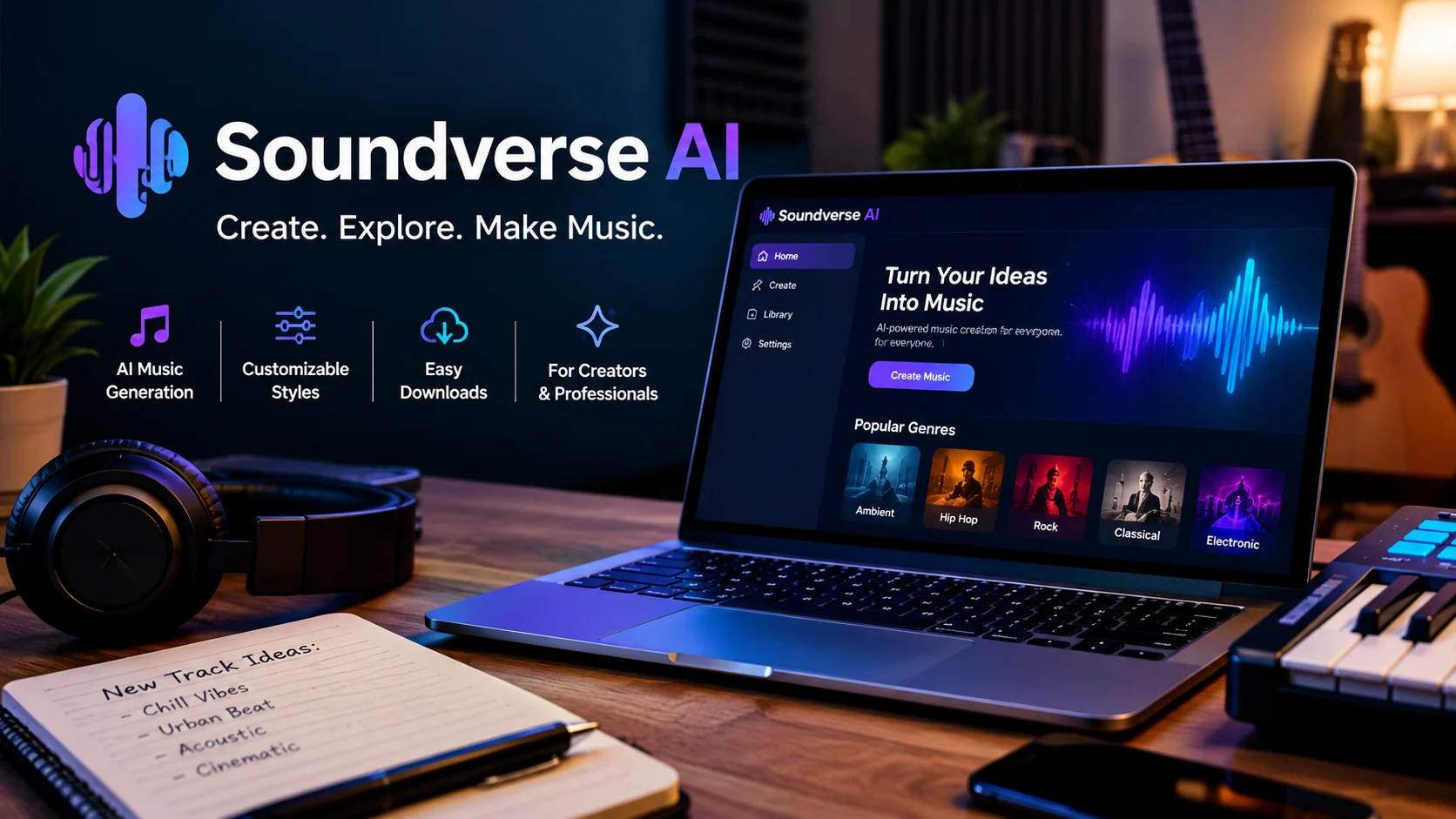
Soundverse AI is a platform in this growing category. It is designed to support AI-assisted music creation, making it relevant to people who want to explore music production without handling every step manually.
Quick Answer: Soundverse AI is an AI-powered music creation platform designed to help users turn musical ideas into audio. It can be useful for musicians, YouTube creators, video editors, and beginners exploring AI-assisted music production. Before using it for commercial projects, check its current pricing, available features, download limits, and music licensing terms.
What Is Soundverse AI?
Soundverse AI is an AI-powered music creation platform that helps users explore and develop music with artificial intelligence. Rather than relying entirely on traditional instruments and manual production, users can work with supported AI-assisted features to turn creative ideas into audio.
The platform belongs to the broader field of generative AI, which uses computational models to create new content based on learned patterns and user input.
In music production, generative AI can help create musical arrangements, explore different styles, and develop audio from descriptions or other supported inputs.
Soundverse AI may appeal to several types of users:
- YouTube creators who need background music for videos.
- Musicians who want to experiment with new musical ideas.
- Video editors who need audio suited to a particular scene.
- Podcast creators who want to explore intro music and transitions.
- Beginners who want to experiment with music production.
- Businesses looking for music for presentations and promotional content.
The platform’s exact capabilities can change over time. Check its official website to confirm which features are currently available under your account or subscription.
How Does Soundverse AI Work?
AI music creation generally involves providing creative instructions, generating audio, and reviewing the results. The exact technical process used by Soundverse AI should not be assumed unless the company documents it.
1. Describe Your Music Idea
The first step is to decide what kind of music you want.
Depending on the available interface, you may be able to describe characteristics such as genre, mood, instruments, or intended use.
For example, you might want calm piano music for a motivational video or dramatic instrumental music for a historical documentary.
A detailed description gives the system a clearer creative direction than a vague request.
2. Generate Music
The AI processes the available input and produces audio based on its capabilities.
Different generations may produce different arrangements, rhythms, instrumentation, or moods. The result may not follow every instruction perfectly, so it is important to evaluate the output.
3. Review and Refine the Result
After generating music, listen carefully to determine whether it matches your original idea.
Pay attention to the overall sound, transitions, repetition, and suitability for your project. If editing or regeneration features are available, use them to improve the result.
Some tracks may require additional editing in an audio production application.
4. Download and Use Your Music
Once you are satisfied with a track, check which export options are available.
Your intended use matters. A soundtrack for a personal project may have different requirements from music used in a monetized YouTube video or a paid advertisement.
Always review the applicable license before publishing or distributing the audio.
Key Features of Soundverse AI
Soundverse AI’s current feature availability should be verified on its official website. The following are the main capabilities worth evaluating when considering an AI music platform.
AI-Powered Music Creation
AI music generation helps users explore musical ideas without manually composing every element.
This can be useful when you need an initial soundtrack, want to experiment with different styles, or are unsure how a creative idea should sound.
However, generated music is not automatically ready for professional use. Some tracks may need adjustments to improve their structure, sound quality, or suitability for a particular project.
Text-Based Music Creation
Text-to-music technology allows users to describe their musical preferences using ordinary language.
A useful description might include:
- Genre, such as electronic, orchestral, or ambient.
- Mood, such as suspenseful, peaceful, or uplifting.
- Instrument preferences, such as piano, strings, or synthesizers.
- Intended use, such as background music or a video intro.
- Desired structure, where supported by the platform.
These details can help communicate your creative direction. The available controls and the system’s ability to follow instructions will determine how closely the output matches your expectations.
Creative Experimentation
AI music platforms can help creators explore several possible directions before committing to a final composition.
For example, a video editor might test different musical moods for the same scene. A songwriter might experiment with alternative arrangements or use generated audio to develop an initial concept.
This makes AI music tools potentially useful during brainstorming and early production.
Music Production Support
Music creation often involves several stages, including composition, arrangement, editing, mixing, and mastering.
AI-assisted tools may help with parts of this process, but their capabilities vary. Do not assume Soundverse AI replaces a complete digital audio workstation or provides every professional production feature.
If you need precise control over individual instruments, timing, or complex arrangements, investigate the available editing options before subscribing.
Audio Export Options
Downloading music is essential when you intend to use it outside the platform.
Before choosing Soundverse AI, check its supported file formats, download restrictions, generation limits, and whether your plan permits the type of use you have in mind.
These practical details can make a significant difference to your workflow.
What Can You Use Soundverse AI For?
The usefulness of Soundverse AI depends on the quality of its output and whether its current features match your creative needs.
YouTube Videos
YouTube creators often need music that supports narration without distracting viewers.
For example, a documentary might benefit from atmospheric instrumental music, while an educational video may need a subtle background track.
AI-assisted music creation can help creators explore different soundtracks. However, always check commercial-use permissions before using generated music in monetized videos.
Social Media Content
Short videos, Reels, and promotional clips often need music that establishes a mood quickly.
Creators can explore AI music tools when looking for audio ideas for storytelling, product demonstrations, tutorials, or social media campaigns.
The final track should fit the video’s duration and pacing. You may need to trim or edit the audio before publishing.
Podcasts
Podcast creators may want music for opening sequences, closing segments, and transitions.
A consistent musical theme can help establish a recognizable identity for a show. Before using Soundverse AI for recurring episodes, check whether the applicable license permits you to reuse the same generated track.
Music and Songwriting Experiments
Musicians can explore AI-generated music to develop early-stage ideas and experiment with different sounds.
A generated track may provide inspiration for a new arrangement or suggest a musical direction worth developing further.
However, musicians should review the output carefully and consider whether additional composition, editing, and mixing are necessary.
Business and Advertising Projects
Businesses may explore AI music for presentations, promotional videos, advertisements, and other branded content.
Commercial projects require particular attention to licensing. A plan that permits personal use may not grant the same rights for client work, paid advertising, or redistribution.
Review the current terms before using generated music in a commercial campaign.
Benefits of Soundverse AI
Accessible Music Creation
Traditional music production can require instruments, recording equipment, software, and technical experience.
AI-assisted tools can reduce some of these barriers by allowing users to experiment with musical ideas through supported digital workflows.
This may be especially useful for beginners and independent creators who do not have access to a recording studio.
Faster Idea Development
Creating music manually can take considerable time, particularly during the early stages of a project.
AI music generation can help users explore possible directions more quickly. However, the actual time saved depends on how closely the generated result matches the intended outcome.
Reviewing and refining audio may still require considerable effort.
Support for Content Creators
Independent creators frequently need music for videos, podcasts, and other digital projects.
An AI music platform may provide another option for developing soundtracks without immediately commissioning a composer.
Its value depends on the quality of the music, subscription costs, licensing permissions, and the amount of editing required.
Opportunities for Beginners
People do not necessarily need extensive musical training to describe the mood or style they want.
Natural-language instructions can make the initial creative process more approachable. Nevertheless, understanding basic audio quality, timing, and licensing remains important.
Limitations of Soundverse AI
Before adopting Soundverse AI, consider the limitations that can affect AI music tools.
Generated Music May Not Match Your Expectations
AI systems can interpret instructions differently from what users intend.
A track might have the right mood but the wrong arrangement, or it might include musical elements that do not suit the project.
Listen to the complete output rather than judging a track by its opening seconds.
Limited Editing Control
Some users need precise control over individual instruments, chord progressions, timing, and transitions.
A prompt-driven workflow may not offer the same flexibility as traditional production software.
Check whether Soundverse AI supports the editing functions you need. If it does not, you may need to export the audio and continue working in another application, provided your plan allows it.
Commercial Licensing Can Be Complicated
Downloading a track does not automatically mean you own every right to it.
The applicable license may determine whether you can use music commercially, redistribute it, include it in client projects, or continue using it under particular subscription conditions.
Read the current terms carefully, especially if you plan to monetize videos or use generated music for business purposes.
Human Review Is Still Important
AI-generated music can require additional work before publication.
You may need to adjust volume, remove unwanted sections, synchronize music with video, or improve transitions.
For professional projects, human review helps ensure that the audio meets the required creative and technical standards.
Soundverse AI Pricing: Is It Free?
Soundverse AI’s pricing and plan details can change. Specific prices, credit allowances, and subscription benefits should be confirmed through the platform’s official pricing page before making a purchase.
When evaluating the available plans, consider these factors:
| Pricing factor | What to check |
| Free access | Whether a free plan or trial is available |
| Monthly subscription | Current monthly fee and included features |
| Annual subscription | Total annual cost and cancellation conditions |
| Generation limits | Credits, generation allowances, or other usage restrictions |
| Credit expiry | Whether unused credits expire or roll over |
| Downloads | Available formats and export restrictions |
| Commercial rights | Whether the plan permits your intended use |
Is the Free Version Enough?
If Soundverse AI offers free access, it may be useful for testing the interface and evaluating the generated audio.
However, free access does not necessarily mean unlimited music creation, unrestricted downloads, or commercial-use permission.
Check the current terms before relying on the service for regular production.
Is a Paid Subscription Worth It?
A paid subscription may make sense if you create music frequently and the available features justify the cost.
Occasional users may need only limited access, while professional creators may require more generations, suitable export options, and clear commercial rights.
Compare the total cost with the amount of usable music you expect to produce. Do not choose a plan based solely on the advertised number of features or generations.
Soundverse AI Alternatives
Soundverse AI is one option in a wider market of AI music creation platforms. Comparing alternatives can help you identify the workflow that best fits your needs.
1. Suno
Suno is an AI music generation platform known for creating songs and music from user instructions.
It may be worth exploring if you want to experiment with vocal tracks, lyrics, and different musical styles.
Compare its current generation limits, download options, and commercial-use terms with those of Soundverse AI.
2. Udio
Udio is another AI music creation platform for users interested in generative music and songwriting.
When comparing Udio with Soundverse AI, examine how well each platform follows instructions, how easily you can refine a result, and whether the output meets your quality requirements.
Check current access and licensing conditions before deciding which service to use.
3. AIVA
AIVA focuses on AI-assisted music composition and may be relevant to creators exploring composed or cinematic music.
It is worth investigating if your project requires a composition-oriented workflow rather than simply generating a quick soundtrack.
Compare the available editing tools, export options, and licensing permissions before subscribing.
4. Soundraw
Soundraw is an AI music platform worth considering for creative projects that require background music.
Video creators should investigate its current editing workflow, supported use cases, and licensing conditions to determine whether it suits their production needs.
5. Stable Audio
Stable Audio is another platform in the generative audio category.
It may be worth exploring if you are interested in AI-generated audio and sound design. Check its current capabilities, access options, and licensing terms to determine whether it meets your requirements.
Soundverse AI vs. Other AI Music Tools
There is no universally best platform for every creator.
| Platform | Potential use case | What to compare |
| Soundverse AI | AI-assisted music creation | Workflow, editing, pricing, and licensing |
| Suno | Song and music generation | Vocal output, structure, and usage rights |
| Udio | Generative music and songwriting | Creative control, output quality, and current terms |
| AIVA | AI-assisted composition | Composition workflow and export options |
| Soundraw | Music for creative projects | Editing capabilities and commercial permissions |
| Stable Audio | Generative audio and sound design | Audio capabilities and licensing |
This is a practical comparison of intended use cases, not a verified ranking of output quality.
Soundverse AI Privacy and Security
Privacy is important when using any online AI music service, especially if you work with unreleased songs, client projects, or confidential audio.
Before uploading material to Soundverse AI, review its current privacy policy and terms of service.
Pay attention to the following questions:
- What information does the platform collect?
- How does it handle uploaded audio and user prompts?
- Does it use submitted content to improve its systems?
- How long is user content retained?
- Can you delete uploaded material and account information?
- Does the service share information with third-party providers?
Do not assume that a platform has a particular security certification or guarantees zero data retention unless its official documentation confirms that claim.
If you work with confidential commercial recordings, obtain clear answers about data handling before uploading them.
Tips for Getting Better Results With Soundverse AI
Write Specific Prompts
Describe the type of music you want rather than using a vague instruction.
For example, you could request calm instrumental music with soft piano, subtle ambient textures, and a reflective mood for a documentary.
Specific descriptions help communicate your creative direction, although they cannot guarantee a perfect result.
Explain the Intended Use
Consider whether the music is intended for a YouTube video, podcast, advertisement, or standalone composition.
Background music for narration usually needs a different balance and arrangement from a song designed to stand on its own.
Review the Entire Track
Listen to the full composition and check for abrupt changes, excessive repetition, unwanted sounds, and sections that do not fit your project.
For videos, make sure the music does not overpower dialogue or distract viewers from the main content.
Compare Multiple Results
If the first generation does not meet your expectations, explore other results when your plan permits it.
Compare the alternatives based on sound quality, mood, arrangement, and suitability for the intended project.
Check Licensing Before Publishing
Save relevant subscription records and copies of applicable licensing terms where permitted.
Remember that keeping a receipt does not create additional usage rights. The license itself determines what you can do with the generated music.
Frequently Asked Questions About Soundverse AI
What is Soundverse AI used for?
Soundverse AI is an AI-powered music creation platform designed to help users develop music with artificial intelligence. Its potential applications include creative experimentation, music production workflows, and audio for digital content, depending on its current features.
Is Soundverse AI free to use?
Free access and its limitations may change. Check the official website for current plans, generation allowances, download restrictions, and commercial-use conditions.
Can I use Soundverse AI music on YouTube?
That depends on the license applicable to your track and account. Review commercial-use terms, attribution requirements, and restrictions on monetized videos before publishing. AI-generated music is not automatically free of copyright claims.
Is Soundverse AI better than Suno or Udio?
There is no single answer for every user. Compare the platforms using similar creative prompts and assess audio quality, editing options, pricing, and licensing. Your ideal choice depends on your project.
Is Soundverse AI suitable for beginners?
It may suit beginners who want to explore AI-assisted music creation. Test the available workflow and determine whether you can generate, review, refine, and export audio that meets your needs.
Conclusion
Soundverse AI is worth exploring if you want to experiment with AI-assisted music creation without producing every element manually. Its value depends on its current features, audio quality, editing options, pricing, and licensing conditions.
YouTube creators may prioritize usable background music, while musicians may need greater creative control. Businesses should pay particular attention to commercial rights and data-handling practices.