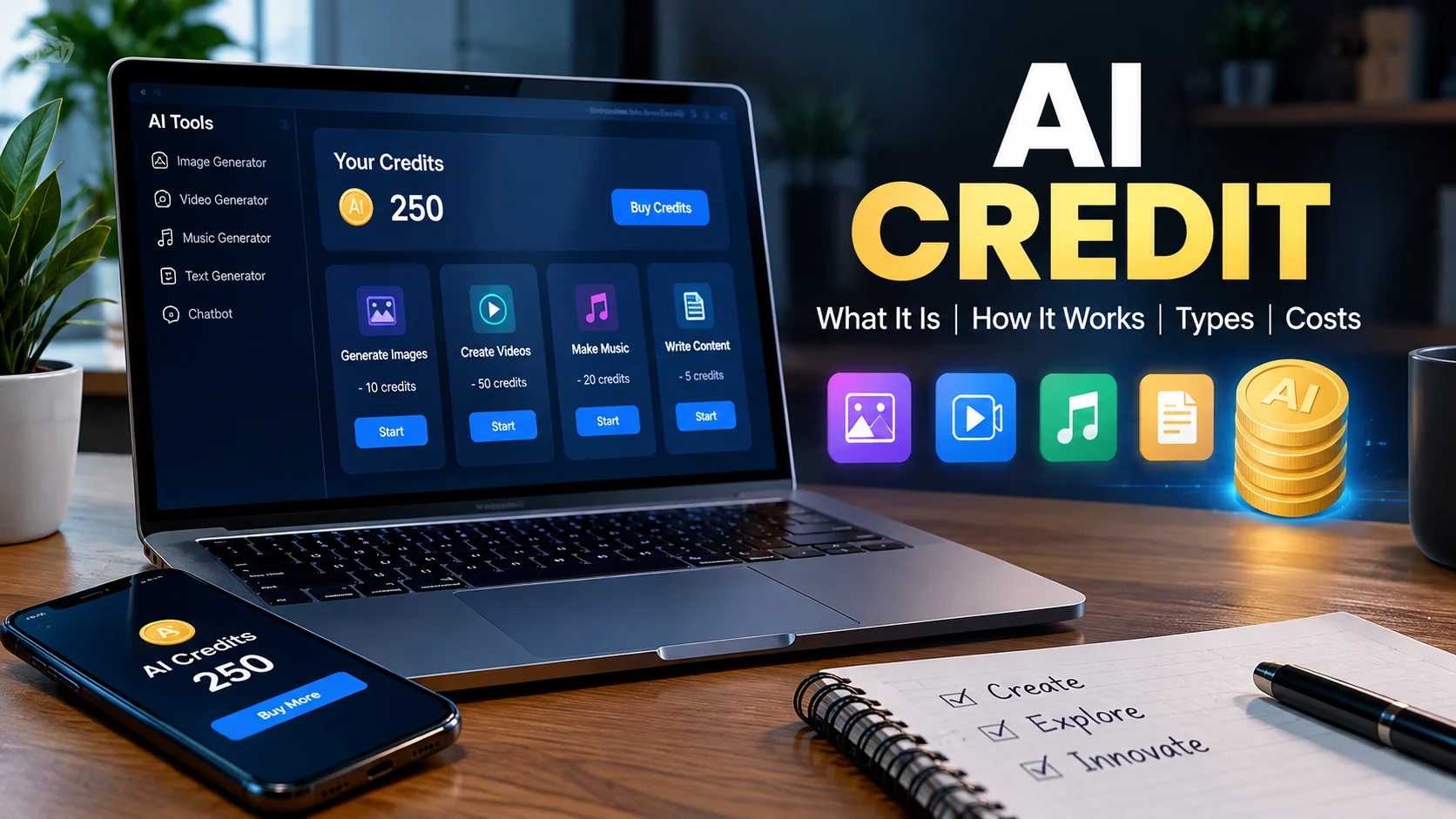
Artificial intelligence tools are becoming increasingly popular for writing, image generation, video creation, music production, and everyday productivity. However, many AI platforms use a credit system to manage access to their features. If you have used an AI image generator or video creation tool, you may have noticed a balance showing how many credits remain in your account.
Quick Answer: AI credit usually refers to a unit used to measure or limit how much you can use an artificial intelligence tool. Platforms may deduct credits when you generate images, create videos, produce music, or use other AI features. The exact value of one credit depends on the platform, the task, and the pricing plan.
What Is AI Credit?
AI credit is a unit of usage that an artificial intelligence platform assigns to certain actions or services. Think of it as a digital allowance that lets you access specific AI features without necessarily paying separately for every request.
For example, an AI image generator might deduct credits whenever you create an image. An AI video platform might charge credits based on video length, resolution, or the model used. A writing assistant might instead provide a monthly usage allowance or limit the number of requests you can make.
The purpose of this system is to help platforms manage computing resources and offer different levels of access to users.
However, one AI credit does not have the same value across all platforms. The number of credits required for a task depends on the provider’s pricing structure and the feature you use.
AI credits may be offered through:
- Free accounts and introductory bonuses.
- Monthly or annual subscriptions.
- One-time credit purchases.
- Promotional offers.
- Usage-based plans.
- Business or enterprise agreements.
Before purchasing credits, always check what they cover and whether they expire.
How Do AI Credits Work?
AI credits generally work through a usage-based system. A platform gives you a certain number of credits, and eligible actions deduct some amount from your available balance.
The exact process differs between services, but the following example illustrates the basic idea.
1. Create an Account
You sign up for an AI platform that uses credits. Depending on the service, you may receive a free allowance or need to choose a subscription.
Some platforms provide free credits to help new users test their features.
2. Choose an AI Feature
You select the task you want to perform. This could involve generating an image, creating a video, producing music, or using an advanced AI model.
Different features may have different credit requirements.
3. Submit Your Request
You provide the necessary instructions, such as a text prompt, image, or other input.
The platform processes your request according to its available features and usage rules.
4. Credits Are Deducted
When the platform performs a credit-consuming action, it deducts the applicable amount from your balance.
For example, suppose a fictional image generator charges two credits per image. If you generate five images, you would use ten credits.
This is only an illustrative example. Actual credit costs vary by provider.
5. Check Your Remaining Balance
After using the service, you can usually check your remaining credits through your account dashboard or billing page.
If your balance reaches zero, you may need to wait for a subscription renewal, claim eligible free credits, upgrade your plan, or purchase additional credits.
Some platforms also impose separate limits, such as daily generation caps or restrictions on particular models.
What Are AI Credits Used For?
AI credits can support many types of artificial intelligence services. Their purpose depends on the platform.
AI Image Generation
AI image generators turn written descriptions into visual content. Users may create illustrations, product concepts, digital artwork, thumbnails, and marketing graphics.
Some platforms charge credits for each generated image, while others calculate usage according to the model, resolution, or number of images requested.
For example, generating several high-resolution images may cost more than producing a single lower-resolution draft.
AI Video Generation
AI video tools can create short clips from text prompts, images, or other inputs.
Video generation may require more computing resources than some simpler tasks. As a result, certain platforms charge different amounts depending on video duration, resolution, generation mode, or model selection.
Before generating a large number of clips, check the credit cost for your preferred settings.
AI Music Generation
Music creation tools can use AI to produce instrumental tracks, songs, and other audio content.
A platform might charge credits for generating a track or using particular music features. Some services may also distinguish between short previews and longer compositions.
The specific rules depend on the provider.
AI Writing and Content Creation
Some writing tools offer a monthly allowance or credit-based access to advanced features.
These features might include long-form content generation, rewriting, summarization, or other specialized tasks.
Not every AI writing assistant uses credits. Some instead rely on message limits, word allowances, subscription tiers, or other usage restrictions.
AI Chatbots and Advanced Models
Certain AI platforms limit access to advanced models through usage quotas or credit-based billing.
In API services, costs may be calculated using tokens, which are small units of text processed by a language model. Other services may use requests, processing time, or task-specific pricing.
Do not assume that a credit-based consumer subscription uses the same billing system as an AI developer API.
Types of AI Credits
The term AI credit can refer to several different types of usage allowances.
Free AI Credits
Free AI credits allow users to test selected features without making an immediate payment.
They may be provided when you register, through a promotional offer, or as part of a limited free plan.
Free credits can be useful for learning how a platform works before committing to a subscription.
However, they may have restrictions. Some expire after a specific period, while others can only be used for certain features.
Subscription-Based AI Credits
Subscription-based credits are included in a paid plan.
For example, a platform may provide a monthly credit allowance that resets when your billing period renews. Users can spend those credits on eligible features during the subscription period.
Check whether unused credits roll over or expire at renewal. These conditions vary between services.
Purchased AI Credits
Some providers let users purchase additional credits separately from a subscription.
This option may help people who occasionally exceed their regular allowance without wanting to change their entire plan.
However, additional purchases can increase your overall spending. Check the price per credit, expiry rules, and eligible uses before buying a package.
Promotional AI Credits
Promotional credits may be offered during product launches, special campaigns, or other limited-time promotions.
They can help users explore a service, but promotional allowances may come with different restrictions from regular subscription credits.
Always read the conditions attached to the offer.
API Usage Credits
AI developer platforms may provide trial credits or other allowances for API usage.
An API allows software applications to communicate with an AI service. Developers can use it to integrate AI capabilities into websites, apps, and automated workflows.
API billing may depend on tokens, requests, generated media, or other measurable resources. Therefore, API credits should not automatically be treated as equivalent to credits in a consumer-facing AI application.
What Is the Difference Between AI Credits and AI Tokens?
AI credits and AI tokens are related to AI usage, but they are not the same thing.
| Feature | AI Credits | AI Tokens |
| Meaning | A platform-defined unit of usage | Small units of text processed or generated by a language model |
| Common use | Consumer AI tools and task-based services | Language model APIs and token-based billing |
| Value | Determined by the provider | Depends on the model’s tokenization and billing rules |
| Cost calculation | May depend on the selected task or feature | Often depends on input and output token counts |
| Universal standard | No | Tokenization also varies between models |
For example, a video generator might charge a fixed number of credits for a clip. A language model API might instead charge based on the number of input and output tokens.
Some platforms can use both concepts internally, but users should follow the billing method documented by their provider.
How Much Is One AI Credit Worth?
There is no universal price for one AI credit.
Its monetary value depends on the platform, subscription, credit package, and features available. Even within the same service, different actions may consume different amounts of credits.
To estimate the monetary cost of a credit, you can divide the price of a credit package by the number of credits included.
For example, imagine a fictional service that sells 1,000 credits for $20.
The estimated cost per credit would be:
$20 ÷ 1,000 = $0.02 per credit.
If a task consumes ten credits, its estimated credit cost would be $0.20 under this example’s pricing assumptions.
These figures are illustrative, not actual prices for any specific AI platform.
Why Credit Value Can Be Misleading
A low price per credit does not necessarily mean a platform is cheaper.
One service may charge five credits for an image, while another charges twenty credits for a comparable task. The second service could still offer a lower effective cost if its credit package is cheaper.
To compare platforms fairly, calculate the cost of completing the same task rather than comparing credit counts alone.
Also consider whether failed generations consume credits, whether taxes apply, and whether unused credits expire.
Do AI Credits Expire?
Some AI credits expire, while others remain available according to the platform’s terms.
The rules commonly depend on how the credits were obtained.
- Free credits: May have an expiration date or promotional restrictions.
- Subscription credits: May reset at the end of each billing period.
- Purchased credits: May remain available for longer, subject to the provider’s conditions.
- Promotional credits: May have separate expiry dates and usage limits.
These are possible arrangements, not universal rules.
Before purchasing credits, look for the provider’s policy on expiration, rollover, refunds, account cancellation, and unused balances. This can help you avoid paying for credits that you do not have enough time to use.
How to Save AI Credits
Managing AI credits effectively can reduce unnecessary spending and help you get more value from an AI platform.
Write Better Prompts
Clear instructions can reduce the need to repeat a task several times.
For image generation, describe the subject, composition, lighting, and intended style. For writing, explain the topic, audience, format, and desired outcome.
A good prompt cannot guarantee a perfect result, but it can make your requests more precise.
Test With Lower-Cost Settings
If the platform offers different quality or generation settings, consider using less expensive options while experimenting.
For example, you might test a visual concept at a lower resolution before producing a final high-resolution image, provided the tool supports this workflow.
Check the actual credit cost of each setting first.
Avoid Unnecessary Regenerations
Before generating another result, identify what needs improvement in the previous one.
Adjust your instructions to address the problem rather than submitting the same request repeatedly.
This approach can help you use your allowance more efficiently.
Track Your Usage
Check your credit balance regularly and review which tasks consume the most credits.
If you frequently run out of credits, calculate the average number of generations you need each month. You can then compare available plans based on actual usage rather than assumptions.
Compare the Total Cost
Do not select a subscription simply because it offers a large number of credits.
Compare the price, task limits, included features, expiration rules, and commercial-use permissions. A smaller allowance may be sufficient if you use the platform occasionally.
Common Mistakes People Make With AI Credits
Understanding the common mistakes associated with AI credits can help you avoid unexpected charges.
Assuming All AI Credits Have the Same Value
Credits are defined by individual providers. A credit from one platform generally cannot be exchanged for a credit from another.
Always evaluate the cost of the actual task you want to complete.
Ignoring Expiration Dates
Users sometimes purchase credits without checking when they expire.
If you do not use the allowance before its expiration date, you may lose access to the unused balance, depending on the provider’s terms.
Confusing Credits With Unlimited Access
Having credits does not necessarily mean every feature is available.
A platform may impose additional limits on generation length, model access, file exports, or daily activity.
Review the plan details before relying on the service for an important project.
Forgetting Commercial Licensing
Credits determine usage allowances, not necessarily ownership or copyright permissions.
Even if you can generate and download an image, video, song, or other asset, you still need to check the license before using it commercially.
Purchasing Too Many Credits
Buying a large package may appear economical, but unused credits can represent wasted spending if they expire or your needs change.
Estimate your expected monthly usage before committing to a large purchase.
Are AI Credits Worth Buying?
AI credits can be worthwhile if you regularly use a platform and understand what you receive in return.
For example, a video creator who frequently generates AI footage may benefit from a plan that provides a predictable monthly allowance. Someone who creates only a few images each month may prefer free access or a smaller package.
The important question is not simply how many credits you receive. It is how much useful work you can complete with them.
Before purchasing, consider your average usage, the cost of each task, the quality of the output, and any restrictions that affect your workflow.
If you are still testing a new platform, start with the smallest suitable commitment. Increase your spending only after confirming that the service meets your needs.
Frequently Asked Questions About AI Credit
What does AI credit mean?
AI credit is a unit that an artificial intelligence platform uses to measure or limit access to certain features. Credits may be consumed when generating images, videos, music, or other AI outputs.
Are AI credits real money?
AI credits are usually usage units rather than money themselves. However, users may purchase them with money or receive them through a subscription. Their monetary value depends on the provider’s pricing structure.
Can I get free AI credits?
Some platforms offer free credits through registration bonuses, free plans, trials, or promotional campaigns. Availability, eligibility, expiration dates, and usage restrictions vary by service.
Do AI credits expire?
Yes, some AI credits expire, while others may remain available according to the provider’s terms. Check the expiration and rollover policies for free credits, subscription allowances, and purchased packages.
What is the difference between AI credits and tokens?
AI credits are platform-defined units used to measure access to features or tasks. Tokens are smaller units of text processed or generated by language models. Credits may cover many kinds of AI tasks, while token-based billing is common in language model APIs.
Conclusion
AI credit is a usage unit that helps artificial intelligence platforms manage access to their services. Depending on the provider, credits may be used for image generation, video creation, music production, writing tools, or other AI-powered features.
The most important point is that AI credits do not have a universal value. Their cost and purchasing power depend on the platform, the task, and the applicable plan.