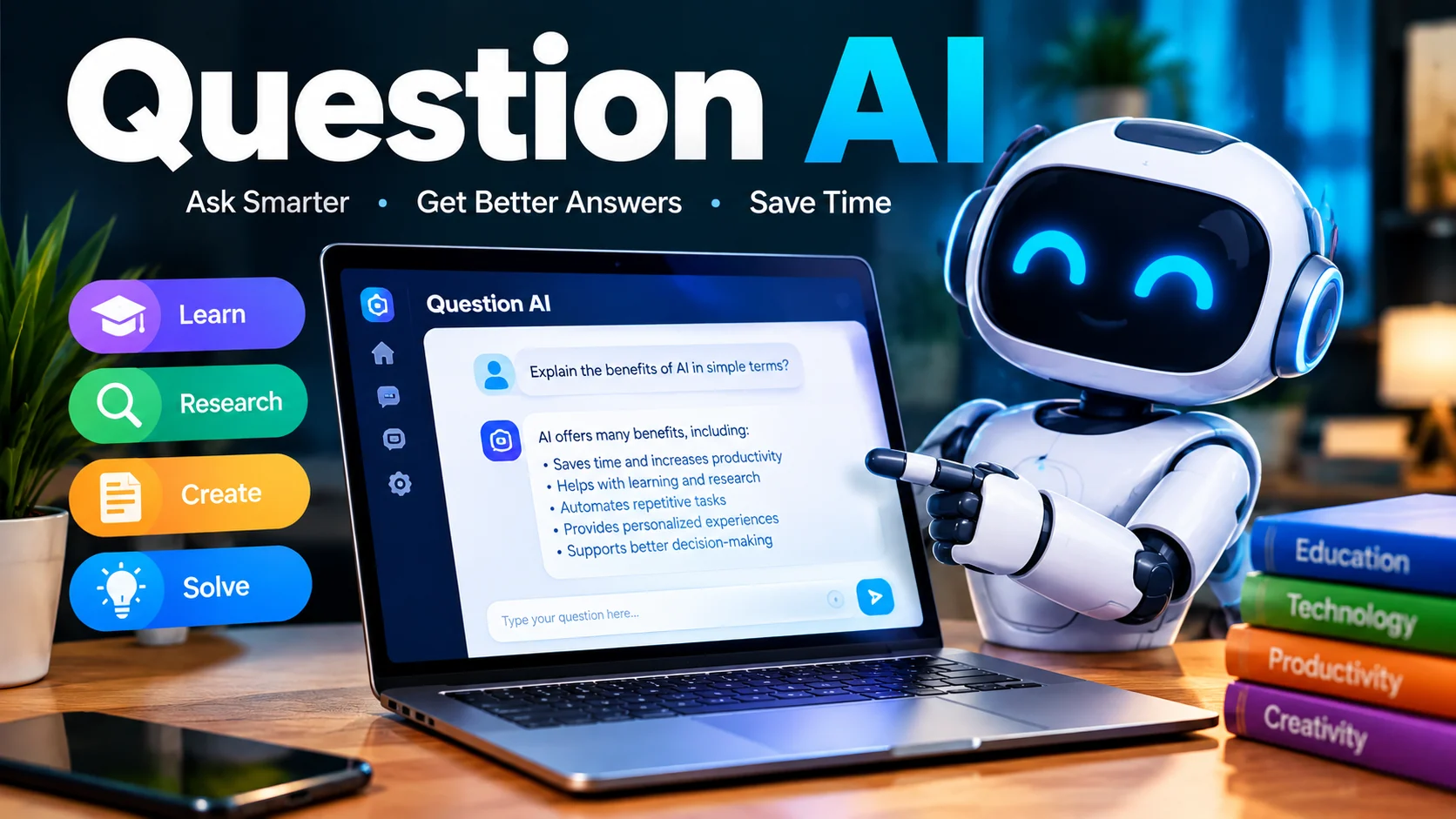
Artificial intelligence is changing how people ask questions, find information, and solve everyday problems. Instead of searching through dozens of web pages, users can now ask AI-powered tools to explain complicated topics, summarize information, generate ideas, and provide step-by-step guidance. This has made question-answering AI tools increasingly useful for students, professionals, researchers, and everyday internet users.
However, the term Question AI can refer to different things. It may describe AI technology that answers questions, a dedicated question-answering platform, or a product using a similar name. Understanding this distinction is important because different tools offer different features, pricing plans, and levels of accuracy.
Quick Answer
Question AI generally refers to an AI-powered tool or technology that answers questions using natural language processing and machine learning. Depending on the platform, it can help with homework, research, writing, explanations, and everyday problem-solving.
What Is Question AI?
Question AI is a term used to describe artificial intelligence tools designed to understand questions and generate relevant answers. These systems use AI techniques to interpret natural language, identify what a user wants to know, and produce a response based on their capabilities and available information.
For example, a student might ask how photosynthesis works. A question-answering AI system could explain the process in simple language, describe the role of sunlight, and outline how plants convert carbon dioxide and water into sugars.
Similarly, a professional could ask for a summary of a long document, while a business owner might request an explanation of a technical concept.
The term does not always refer to one specific product. Some people use Question AI as a general description of AI question-answering technology, while others may be searching for a particular website or application branded with that name.
If you are looking for a specific Question AI product, verify its official website, available features, and terms before creating an account or purchasing a subscription.
How Does Question AI Work?
AI question-answering systems combine language processing, learned patterns, and, in some cases, access to external information. Their exact architecture depends on the platform.
1. Understanding the Question
When you submit a question, the AI system processes the words and attempts to identify the meaning, context, and intent.
For example, the question “Why does the moon change shape?” is likely asking about the phases of the Moon rather than a physical change to the Moon itself.
Understanding the wording helps the system generate a more relevant response.
2. Processing the Information
Many modern question-answering tools use large language models, commonly known as LLMs. These models learn patterns from training data and use those patterns to generate text in response to instructions.
Some platforms may also retrieve information from documents, search indexes, or connected sources. This can help them answer questions using material beyond the model’s internal knowledge.
However, not every Question AI tool uses the same models or information sources.
3. Generating an Answer
After processing the question, the system produces a response in natural language.
Depending on the tool, the answer may include explanations, examples, summaries, calculations, or structured lists.
The quality of the result depends on factors such as the model’s capabilities, the clarity of the question, the available context, and the reliability of the information used.
4. Refining the Response
Many conversational AI tools allow users to ask follow-up questions.
For example, after receiving an explanation of gravity, a student could ask for a simpler version or request an example involving everyday objects.
This interactive process helps users explore a topic without having to start a completely new search each time.
Main Features of Question AI
Features vary between platforms, but AI question-answering tools commonly focus on understanding questions and making information easier to access.
Instant Question Answering
One of the main purposes of question-answering AI is to provide responses in conversational language.
Users can ask questions about science, technology, history, language, general knowledge, and many other subjects.
The speed of a response does not guarantee its accuracy, so important claims should still be checked against reliable sources.
Homework Assistance
Some AI tools help students understand academic topics, work through practice problems, and review difficult concepts.
For example, a student studying algebra might ask for a step-by-step explanation of an equation. A language learner could request examples of a grammatical rule.
Students should use these tools to develop understanding rather than simply copying answers. They should also follow their school’s rules regarding AI-assisted work.
Explanations of Difficult Topics
AI tools can rephrase complicated information in simpler language.
A user could ask for an explanation of machine learning suitable for a beginner, followed by a more technical explanation for an advanced reader.
This flexibility can make unfamiliar topics easier to explore.
Writing and Summarization
Some question-answering platforms also provide writing assistance, summaries, rewriting, and text analysis.
These capabilities may help users understand long documents or organize information before preparing their own work.
Check the specific platform’s supported features because not every tool includes all these functions.
Image or Document Questions
Certain AI systems can analyze uploaded documents, images, or screenshots and answer questions about their contents.
For example, a user might upload a page of study notes and ask for a summary.
This capability is not universal. Before uploading files, confirm that the platform supports the relevant format and understand how it handles submitted information.
Conversational Follow-Ups
Conversation-based systems can use previous messages in the same interaction to understand follow-up questions.
This allows users to ask for clarification, request examples, or explore a topic in greater detail.
However, the amount of conversation a system can consider depends on its context limits and implementation.
What Can You Use Question AI For?
Question-answering AI can support a wide range of everyday and professional activities.
Education and Studying
Students can use AI tools to clarify lessons, review concepts, generate practice questions, and prepare for examinations.
For example, someone studying biology might ask the system to compare plant and animal cells. They could then request a table or a simpler explanation of the differences.
AI-generated explanations should be compared with textbooks, course materials, and teacher guidance, particularly when preparing for assessments.
Research and General Knowledge
Researchers and curious readers can use AI to explore unfamiliar subjects, identify relevant concepts, and organize questions for further investigation.
Some tools can also summarize provided documents or search connected sources.
For serious research, verify factual claims using primary sources, academic publications, or reputable reference materials. An AI-generated answer alone is not sufficient evidence.
Business and Professional Work
Professionals may use question-answering AI to understand technical documentation, summarize reports, brainstorm solutions, and prepare initial drafts.
For example, an employee could ask an AI assistant to explain a complex software concept in plain English.
Businesses should avoid submitting confidential information to a platform without first reviewing its privacy and data-handling policies.
Writing and Content Creation
Writers and content creators can use AI to develop outlines, clarify unfamiliar topics, identify potential questions, and generate ideas.
However, generated content still needs human editing and fact-checking. Publishing unverified answers can introduce errors and reduce the reliability of an article.
Everyday Problem-Solving
Question AI can also help with ordinary tasks, such as understanding a technology setting, learning a new skill, planning a project, or comparing different options.
Its usefulness depends on the quality of the question and the reliability of the answer.
Benefits of Question AI
Easy Access to Information
AI question-answering tools let users ask questions in everyday language instead of learning specialized search techniques.
This can make information more accessible to people who find traditional research difficult.
Personalized Explanations
Users can request simpler explanations, additional examples, or different levels of detail.
This can be especially helpful when learning a new subject or revisiting a concept that was previously confusing.
Time-Saving Assistance
AI can help summarize information, organize ideas, and provide starting points for research.
However, users should account for the time needed to verify claims and correct mistakes. A quick answer is not necessarily a complete or reliable one.
Support for Different Skill Levels
Beginners may benefit from introductory explanations, while experienced users can request more detailed discussions.
The degree of personalization varies by platform and does not necessarily mean the system understands the user’s needs perfectly.
Convenient Follow-Up Questions
Conversational interfaces allow users to build on earlier answers.
Instead of repeating the entire context, users can ask for clarification or explore a related detail within the same conversation.
Limitations of Question AI
Despite its benefits, question-answering AI has important limitations.
AI Can Produce Incorrect Answers
Some AI systems generate plausible-sounding statements that are inaccurate, incomplete, or unsupported. This behavior is commonly associated with AI hallucinations.
A response can be confidently written and still be wrong.
Check important information against trustworthy sources, particularly for medical, legal, financial, and academic decisions.
Information May Be Outdated
Not every AI system has live internet access. Some rely primarily on information learned during training, which may not reflect recent developments.
If a question concerns current prices, recent events, product features, or changing policies, use a tool that can access current sources and verify the information independently.
Questions May Be Misunderstood
A vague question can lead to an answer that misses the user’s actual intent.
Providing context, explaining the goal, and specifying the desired format can improve the relevance of the response.
If the answer seems unrelated, clarify the question rather than assuming the tool has understood it correctly.
Source Quality Can Vary
Some platforms provide citations or links, while others generate answers without identifying specific sources.
Even when citations are provided, check that the sources exist and actually support the claims being made.
Privacy Concerns
Questions may contain personal details, confidential documents, or sensitive business information.
Before using an AI platform, review its privacy policy, data-retention practices, and options for managing or deleting submitted information.
Avoid uploading sensitive information unless you understand how the service handles it.
Is Question AI Free?
Whether Question AI is free depends on the specific product you mean.
Some AI question-answering tools offer free access with usage limits. Others use subscriptions, paid features, credits, or usage-based pricing.
A free plan might restrict the number of questions, access to advanced models, document uploads, or other capabilities. Paid plans may offer additional features, but their value depends on your needs.
Before subscribing, check:
- Whether a free plan is available.
- How many questions or requests are included.
- Whether advanced features require payment.
- Whether document or image analysis has separate limits.
- Whether unused credits expire.
- The cancellation and renewal conditions.
I cannot confirm the current pricing of a particular product called Question AI here. Consult its official website for current prices and plan details.
Question AI Alternatives
If you want an AI tool that answers questions, several established alternatives are worth considering.
ChatGPT
ChatGPT is a conversational AI assistant that can explain concepts, answer questions, help with writing, and support many other tasks.
Its available capabilities depend on the model, account, and tools enabled.
Google Gemini
Google Gemini is Google’s AI assistant. It can help users explore topics, generate content, and work with supported information sources and features.
Availability and capabilities vary by product and account.
Microsoft Copilot
Microsoft Copilot provides AI assistance across supported conversational and productivity experiences.
It may be useful for people who want help with research, explanations, or tasks connected to Microsoft’s products and services.
Perplexity
Perplexity is an AI-powered answer and search platform designed to help users research questions and explore sources.
It can be worth considering when source discovery and checking references are important parts of your workflow.
Comparison of Question-Answering AI Tools
| Tool | Main purpose | What to consider |
| Question AI | Depends on the specific product using this name | Verify the official service, features, and pricing |
| ChatGPT | Conversational assistance and general-purpose tasks | Available tools, usage limits, and source verification |
| Google Gemini | AI assistance and information-related tasks | Supported integrations and current capabilities |
| Microsoft Copilot | AI assistance and supported productivity workflows | Product integration and plan requirements |
| Perplexity | AI-assisted search and research | Source quality, citations, and current access limits |
This is a general overview, not a live feature or price comparison. Each platform changes over time, so confirm the details directly before choosing one.
How to Get Better Answers From Question AI
The quality of an AI response often depends on how clearly you communicate what you need.
Ask Specific Questions
Instead of asking, “Explain science,” try asking, “Explain how photosynthesis works for a middle-school student.”
A focused question gives the system a clearer direction.
Provide Relevant Context
If you need help with a particular assignment, technical issue, or document, include the relevant details.
Avoid sharing personal or confidential information that the platform does not need to answer the question.
Request Examples
Examples can make abstract ideas easier to understand.
You can ask for a practical example, a comparison table, or a step-by-step explanation, depending on the subject.
Ask for Sources
For factual questions, request references or links to reliable sources when the tool supports them.
Verify those sources independently instead of assuming every citation is accurate.
Check Important Answers
Use textbooks, official documentation, government websites, academic research, or other appropriate primary sources to verify high-stakes information.
Treat AI as an assistant for understanding and exploring information, not an unquestionable authority.
Is Question AI Safe to Use?
Safety depends on the specific platform, its data practices, and how you use it.
For ordinary learning and general questions, an established service with clear policies may be a reasonable starting point. However, no AI platform should automatically be assumed to provide complete privacy or perfectly accurate answers.
Before using a particular Question AI website or app, check its official domain, privacy policy, account requirements, and payment terms.
Be cautious if a service requests unnecessary personal details, makes unrealistic accuracy promises, or provides unclear subscription conditions.
For health, legal, and financial matters, use AI-generated explanations as a starting point and consult qualified professionals when necessary.
Frequently Asked Questions About Question AI
What is Question AI used for?
Question AI generally refers to an AI-powered tool or technology that answers questions using natural language processing and machine learning. Depending on the platform, it can help with education, research, writing, explanations, and everyday problem-solving.
Is Question AI free?
Some question-answering AI tools offer free plans, while others require subscriptions or charge for advanced features. Availability, usage limits, and prices depend on the specific product.
Can Question AI solve homework questions?
Some AI question-answering tools can explain academic concepts and help users work through homework problems. Students should verify the answers, understand the reasoning, and follow their school’s rules for AI assistance.
Is Question AI always accurate?
No. AI systems can produce incorrect, incomplete, or outdated information. Verify important claims with reliable sources, especially when the answer could affect a significant decision.
What are the best alternatives to Question AI?
Potential alternatives include ChatGPT, Google Gemini, Microsoft Copilot, and Perplexity. The most suitable option depends on whether you prioritize explanations, research, productivity features, or source discovery.
Conclusion
Question AI describes a growing category of artificial intelligence tools that help people ask questions and receive natural-language answers. These tools can support studying, research, writing, and everyday problem-solving.
Their main advantages include convenience, flexible explanations, and the ability to explore topics through follow-up questions. However, accuracy, privacy, source quality, and access limits remain important considerations.